


Batteries play a critical role at seismic and other geophysical stations in ensuring that the equipment receives uninterrupted power to make continuous observations of the Earth. Often sited in remote environments under a wide range of environmental conditions, these stations have almost ubiquitously used conventional lead‐acid batteries. However, recent advances in rechargeable lithium‐ion battery technology have led to the development of lithium‐iron phosphate (LFP) batteries that can replace lead‐acid batteries in energy storage systems. In the past three years, LFP battery production has grown over an order of magnitude, reducing their cost and increasing their availability. In this article, we examine the benefits and challenges associated with incorporating several types of LFP batteries into the power systems of geophysical stations. We review how fundamental differences in battery chemistry enable LFP batteries to weigh less than half of comparable lead‐acid batteries and may have longer service lives but have the added complexity of being managed by an integrated battery monitoring system (BMS) microcontroller. Through a controlled heat chamber experiment, we demonstrate that LFP batteries can be ideally suited for use in high‐temperature environments by offering longer service lives than lead‐acid batteries. However, for safety reasons, the BMS prevents most LFP batteries from being charged at temperatures <0°C, which complicates their use in colder regions and can lead to equipment damage if the charging system is not appropriately designed for this battery type. Finally, we address some of the unique challenges associated with adopting lithium batteries, including unexpected substantial (≤14 W) power consumption from the BMS, safety concerns, and shipping restrictions. It is our goal to help inform station operators and geophysicists about potential benefits and issues that can arise from using LFP batteries at seismic and geophysical stations in a range of environments.
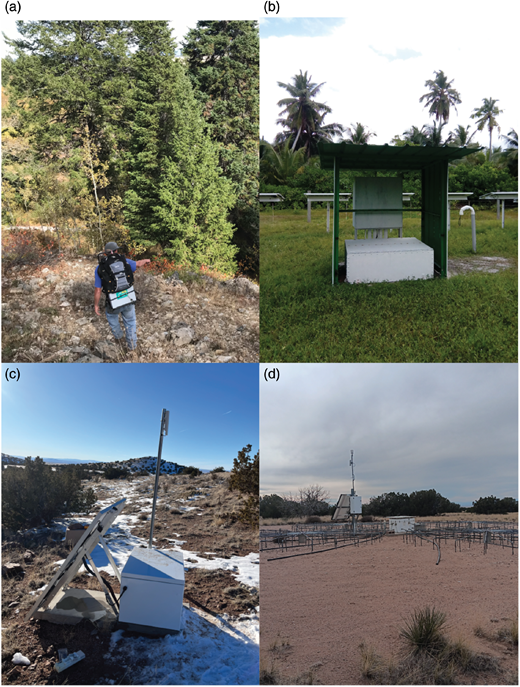
Figure 1: Seismic stations and power systems operating in a wide range of environmental conditions. (a) Steve Roberts (U.S. Geological Survey) hikes up a lead‐acid battery to Intermountain West Seismic Network (Network Code: IW) station MOOW (Moose Ponds, Wyoming; Photo Credit: Dolan Paris). (b) The battery box for International Monitoring System station I52 located on Diego Garcia Island. (c) Albuquerque Seismological Laboratory array Station ASA2 after a cold snap in January 2024 damaged the wireless bridge and took down the station (Fig. 6). (d) Facility for Acceptance, Calibration, and Testing (FACT) infrasound array station FSA3.